How to Calculate CCA: Half-Year Rule + Worked Example
Tutorly · Canadian Tax
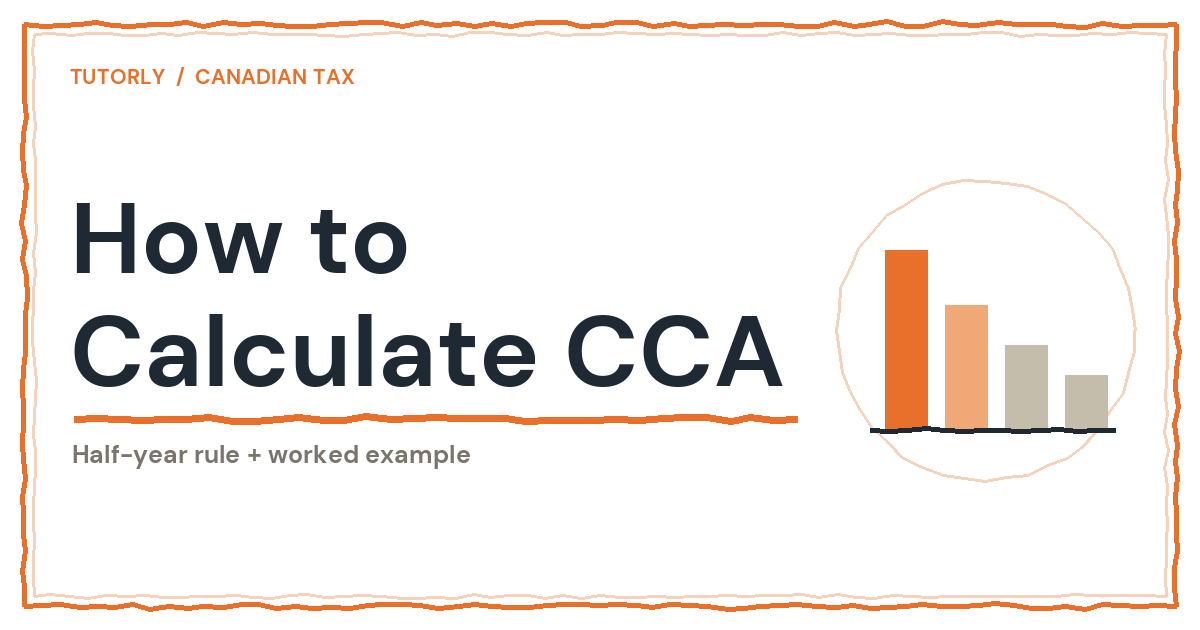
How to Calculate CCA: Half-Year Rule + Worked Example
To calculate CCA (capital cost allowance), you find the asset’s CCA class and rate, apply that rate to the balance on a declining-balance basis, and in year one claim on only half the addition (the half-year rule). CCA is Canada’s tax version of depreciation — US “MACRS” guides won’t help you here; this is the CRA’s system.
What is CCA?
Capital cost allowance (CCA) is the yearly tax deduction the CRA lets you claim for the cost of a capital asset, spread over several years instead of all at once. You usually can’t deduct the full cost of a capital asset (equipment, furniture, a building) in the year you buy it. Instead the CRA lets you deduct a portion each year as capital cost allowance. Each asset sits in a numbered class with a set rate, and you deduct that rate off the remaining balance — the undepreciated capital cost (UCC) — every year.
The CCA formula
How do you calculate capital cost allowance? (worked example)
A Calgary design studio buys $18,000 of office furniture in 2026. Furniture is Class 8 (20%).
Find the class & rate. Office furniture → Class 8 → 20% declining balance.
Apply the half-year rule (year 1). Only half the addition earns CCA: base = $18,000 × ½ = $9,000.
Year 1 CCA = $9,000 × 20% = $1,800.
Carry the balance forward. UCC = $18,000 − $1,800 = $16,200.
Year 2 CCA = $16,200 × 20% = $3,240 (no half-year rule after year 1).
| Year | Opening UCC | CCA (20%) | Closing UCC |
|---|---|---|---|
| 2026 | $18,000 | $1,800 | $16,200 |
| 2027 | $16,200 | $3,240 | $12,960 |
| 2028 | $12,960 | $2,592 | $10,368 |
Opening UCC × rate = CCA, then Opening UCC − CCA = Closing UCC. Carry the closing UCC forward as next year’s opening balance.Stuck on a CCA question with your own numbers? A tutor can walk through your assignment line by line — book a session.
The mistakes that cost marks
Three trip students up: forgetting the half-year rule in year one, re-applying it in later years (you don’t), and mixing up the rate. CCA is also optional — you can claim any amount up to the maximum, which is how businesses smooth taxable income. Need the rates? See the full CCA classes table.
Frequently asked questions
How do you calculate capital cost allowance?
Find the asset’s CCA class and rate, apply the rate to the undepreciated capital cost on a declining-balance basis, and in the year of purchase claim on only half the addition (the half-year rule).
What is the half-year rule?
In the year you buy an asset you can usually claim CCA on only half the net addition; the full balance earns CCA in later years.
Is CCA mandatory?
No — CCA is optional. You can claim anywhere from zero up to the maximum, which is useful for managing taxable income across years.
What’s the difference between CCA and depreciation?
Depreciation is the accounting expense in your financial statements; CCA is the tax deduction the CRA allows. They follow different rules and rarely equal each other.
What is the CCA formula?
CCA equals the undepreciated capital cost (UCC) times the asset’s class rate. In the year of purchase you apply the rate to only half the addition (the half-year rule), then to the full UCC in later years.
How does CCA work?
Each asset goes in a CCA class with a set rate. You deduct that rate off the balance each year on a declining-balance basis, so the deduction shrinks as the undepreciated capital cost falls.
What is UCC?
UCC (undepreciated capital cost) is the remaining balance of an asset’s cost that hasn’t yet been claimed as CCA. It’s the opening balance you apply the rate to each year.
Taking a Canadian tax course?
Get 1-on-1 tutoring on CCA, UCC, and recapture with worked problems from your own course — from a CFA/CFP who teaches this.
Book a session →