Intermediate Accounting: Why It’s Hard + How to Pass (Canada)
Complete Guide · Canada
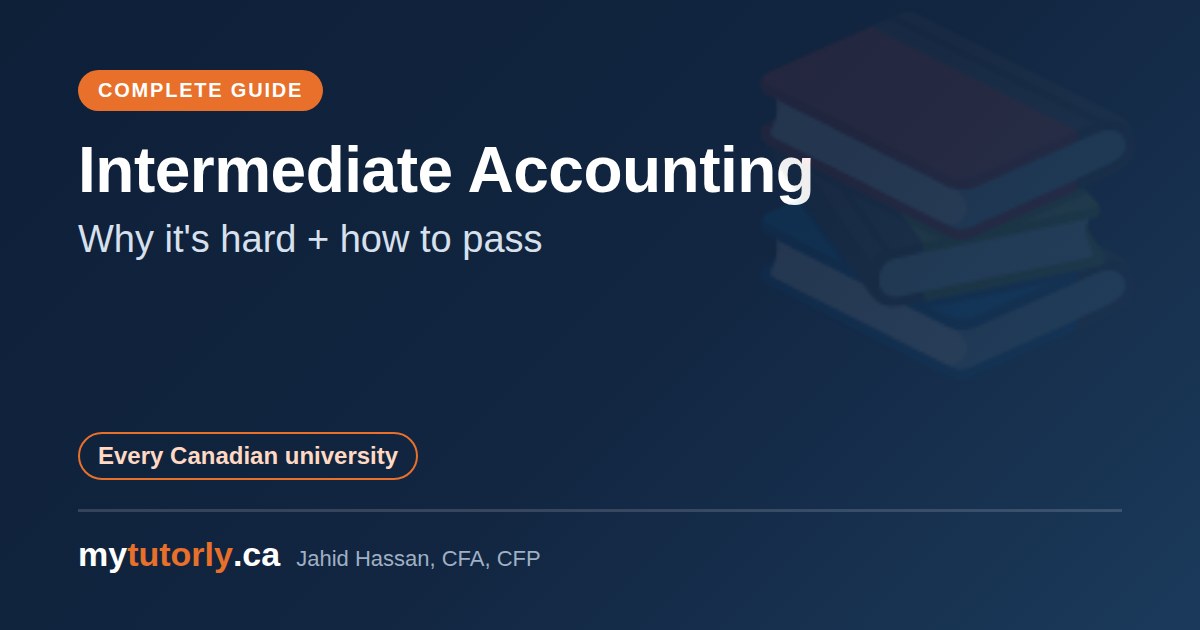
Intermediate Accounting: Why It’s Hard and How to Pass
Intermediate accounting changes the game. Intro rewarded memorizing entries; intermediate makes you choose and defend the right standard, do present-value math on almost everything, and carry it under exam pressure. It splits in two: Intermediate I is the asset side (revenue, receivables, inventory, PP&E); Intermediate II is the liabilities-and-equity side (debt, taxes, pensions, leases, EPS, cash flows).
What intermediate accounting covers
Every topic, and what it tests
| Topic area | What it covers | Course |
|---|---|---|
| Conceptual framework | Recognition, measurement, IFRS vs ASPE | Interm. I |
| Revenue recognition (IFRS 15) | The five-step model, contract issues | Interm. I |
| Cash & receivables | Allowance for doubtful accounts, notes receivable | Interm. I |
| Inventory | Cost formulas (FIFO, weighted average), NRV | Interm. I |
| Property, plant & equipment | Capitalization, depreciation, componentization | Interm. I |
| Intangibles & impairment | Recognition, amortization, impairment tests | Interm. I |
| Financial instruments | Classification & measurement of investments | Interm. I/II |
| Financial liabilities & bonds | Effective-interest amortization | Interm. II |
| Leases (IFRS 16) | Right-of-use asset & lease liability | Interm. II |
| Income taxes | Temporary differences, deferred tax | Interm. II |
| Pensions & employee benefits | Defined benefit vs contribution | Interm. II |
| Shareholders’ equity & EPS | Share issuance, dividends, basic/diluted EPS | Interm. II |
| Accounting changes | Retrospective vs prospective, error correction | Interm. II |
| Statement of cash flows | Indirect method, complex adjustments | Both |
Where students actually lose marks
Not the easy topics — the ones with judgment and multi-step calculations: revenue recognition, impairment, financial instruments, leases, and deferred tax. Treat each standard as a template — recognize, measure, journalize, disclose — and the course becomes a set of repeatable patterns instead of a wall of rules.
Find your course
| University | Intermediate I | Intermediate II |
|---|---|---|
| U of Alberta | ACCTG 314 → | ACCTG 315 → |
| U of T (Rotman) | RSM 220 → | RSM 221 → |
| U of T · Interm. III | RSM 320 → Intermediate Financial Accounting III | |
| U Calgary (Haskayne) | ACCT 341 → | ACCT 343 → |
Why students fail it
Three reasons that compound: the volume is much higher than intro; the material is cumulative, so a shaky September breaks November; and exams reward judgment, not recall — you must know which standard applies and why. Studying by re-reading notes gets you blindsided, because the exam asks you to apply, not repeat.
How to pass intermediate
- Study problems, not chapters — work full questions under timed conditions.
- Master present-value math early — it shows up in bonds, leases and pensions.
- Explain why a standard applies — that’s the exact skill the exam tests.
FAQ
Why is intermediate accounting so hard?
It shifts from recording transactions to applying judgment under IFRS/ASPE, with far more volume and heavy present-value math — and it’s cumulative, so falling behind snowballs.
What’s the difference between Intermediate I and II?
Intermediate I covers the asset side (revenue, receivables, inventory, PP&E); Intermediate II covers liabilities, equity, taxes, pensions, leases, EPS, and cash flows.
Can I catch up if I’m already behind?
Yes, but move now — target the foundational topics (revenue recognition, present-value math) first, since everything else builds on them.
Struggling with intermediate?
It’s one of the courses we tutor most — we’ll target the exact topics costing you marks.
Book a session →Related: Intermediate accounting tutoring · Why intermediate feels so hard